Off-Grid Living for Beginners: Solar Panels and Water Systems
Imagine waking up in the morning. You turn on the light, make coffee, and take a shower. But here is the magic: you did not pay an electric company for the light. You did not pay the city for the water. You collected it all yourself from the sun and the sky.
This is the dream of Off-Grid Living.
Living off-grid means you are not connected to public utilities. No power lines, no water pipes, no sewer connection. You are independent.
However, becoming your own power plant and water company can be scary for beginners. How does it work? What do you need? In this guide, we will explain the two most important systems: Solar Power and Water Systems in simple terms.
Part 1: The Solar Power System (Your Electricity)
When you live in a regular house, electricity comes through a wire. When you live off-grid, you must make it yourself. The most common way to do this is with solar panels.
You cannot just plug your toaster into a solar panel. You need a complete system. Here are the four main parts you need to know:
1. The Solar Panels (The Collectors)
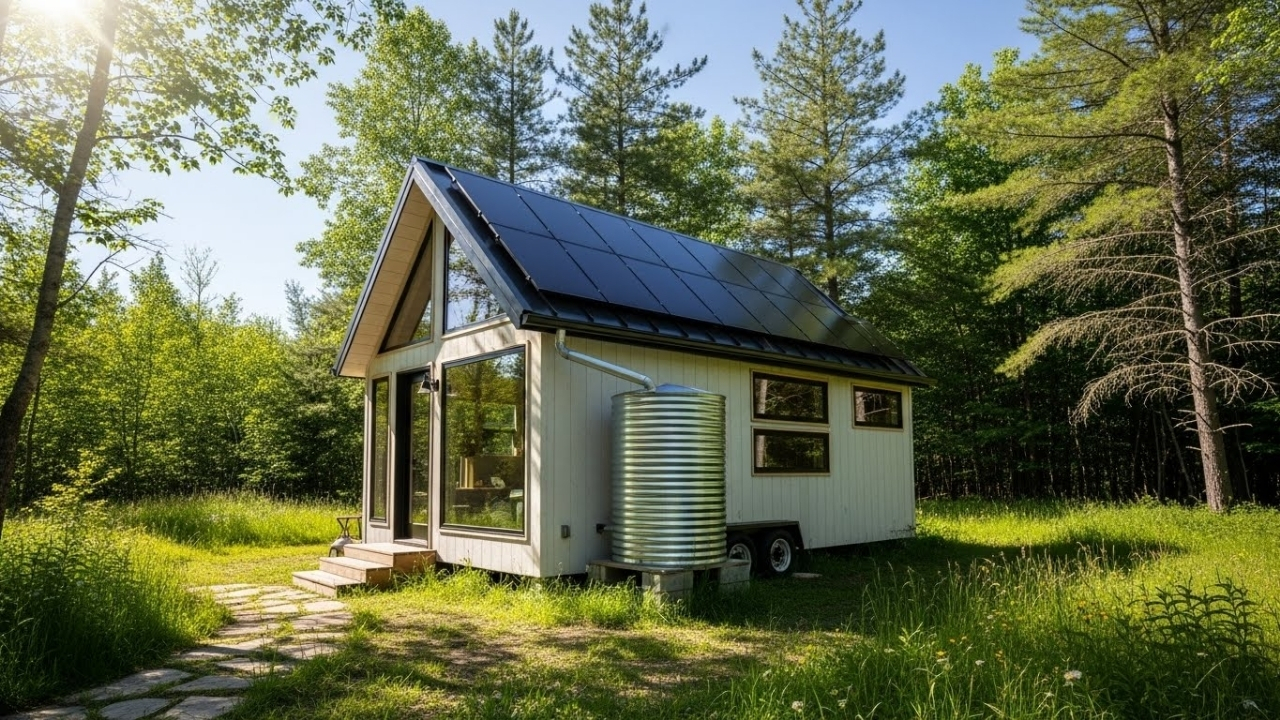
These are the black glass rectangles you see on roofs. They sit in the sun and catch energy.
-
How it works: Sunlight hits the panel and turns into electricity.
-
Tip: You need to park your tiny house where there is no shade. Shadows are the enemy of solar power.
2. The Charge Controller (The Guard)
The energy from the panels flows to the batteries. The charge controller stands in the middle.
-
How it works: It stops the batteries from getting too full (overcharging). It protects your expensive batteries from damage.
3. The Battery Bank (The Storage)
The sun does not shine at night. But you still want to watch a movie or turn on a light.
-
How it works: The batteries store the energy during the day so you can use it at night.
-
Choice: Lithium batteries are expensive but last a long time. Lead-acid batteries (like car batteries) are cheaper but heavy and require maintenance.
4. The Inverter (The Translator)
This is very important. The electricity in your batteries is “DC” (Direct Current). But your laptop and TV use “AC” (Alternating Current).
-
How it works: The inverter takes the DC power from the battery and turns it into AC power for your plugs.
Part 2: The Water System (Your Life Source)
Water is heavy, and we use a lot of it. In a normal house, you turn the tap and water comes out. Off-grid, you have to find the water first.
1. Getting Water (Collection)
There are two main ways to get water off-grid:
-
Rainwater Catchment: This is the most popular method for tiny houses. You put gutters on your roof. The rain hits the roof, goes into the gutter, and flows down into a large plastic tank.
-
Hauling Water: If it does not rain enough, you might need to buy water. You fill a portable tank at a friend’s house or a camping station and drive it to your home.
2. Cleaning Water (Filtration)
Rainwater is not perfectly clean. It touches your roof, where birds might sit. Before you drink it, you must filter it.
-
Sediment Filter: Removes dirt and leaves.
-
Carbon Filter: Removes bad tastes and chemicals.
-
UV Light: This is crucial. A UV light kills bacteria and viruses. Never drink rainwater without proper filtration.
3. Heating Water
How do you take a hot shower? You have two options:
-
Propane Heater: This is an “on-demand” heater. It uses gas to heat water instantly when you turn the tap.
-
Solar Water Heater: Uses the sun to heat water in a black tube. It is free but only works on sunny days.
Part 3: Managing Waste (Where Does it Go?)
If you are not connected to a sewer line, you cannot flush a normal toilet. Where does the waste go?
The Composting Toilet
This is the best friend of the off-grid tiny house. It does not use water.
-
How it works: It separates liquid from solid waste. You cover the solid waste with sawdust or coconut fiber. Over time, it turns into soil (compost). Ideally, it does not smell if you use it correctly.
Grey Water
This is the water from your sink and shower. It is a little dirty (soap and toothpaste), but not dangerous.
-
Disposal: You can usually filter this through a grease trap and let it water your garden plants (check your local laws first).
Conclusion: Start Small
Going off-grid is a big learning curve. You will learn to look at the weather forecast. You will learn to save water when you brush your teeth.
But the reward is huge. You will have no monthly bills. You will be free.
If you are a beginner, start with a simple calculation: Write down how many watts your laptop and lights use. This will tell you how many solar panels you need. The journey to independence starts with a single step.
